From Mad Moon to Silent Hour: A Night with Đorđe Kujundžić
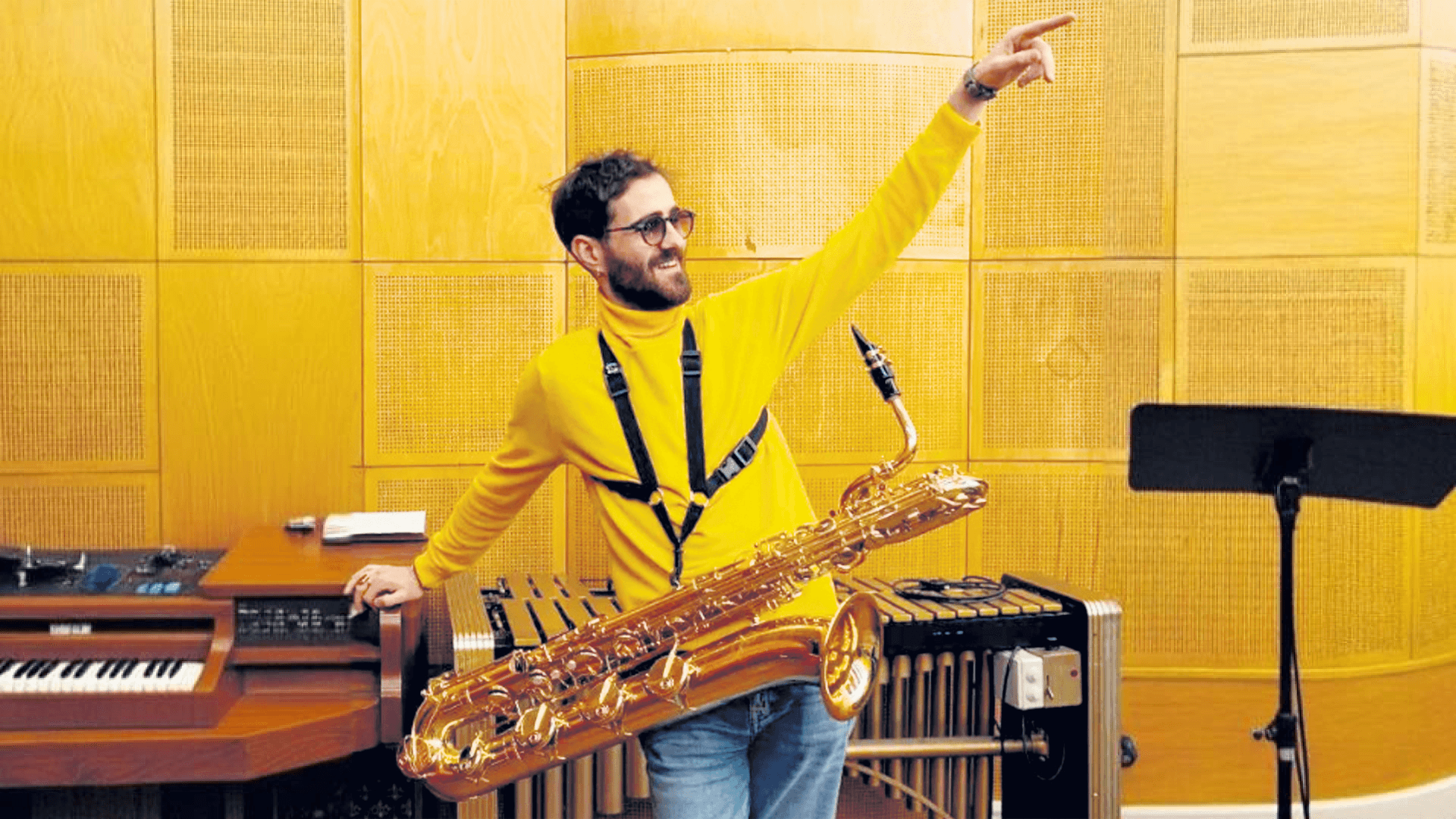
Đorđe Kujundžić’s debut album The Sound of Night marks his arrival as a baritone saxophonist and composer, leading a compact quartet through eight original compositions. Focused on strong themes, restrained improvisation, and a nocturnal atmosphere, the album presents a mature and cohesive jazz statement.
Column: Jazz Sketches
Author: Vojislav Pantić
The Sound of Night - Bluzika Records, 2025
Saxophonist, clarinetist, and composer Đorđe Kujundžić was born in Belgrade in 1993. He received his formal education as a classical clarinetist: he completed secondary music school “Vatroslav Lisinski” in Belgrade, earned his undergraduate degree at the conservatory in Lugano, and obtained his master’s degree at the music academy in Lucerne. His thesis, The Melodic Library of Babel, was inspired by the short story “The Library of Babel” by Jorge Luis Borges.
Together with fellow students, he formed the collective The Sharp Shock, just a few weeks before further education and career paths scattered them across different parts of the continent, they released the album Canon (United Soloist, 2018). Kujundžić then returned to Serbia, enrolled in jazz studies at the Faculty of Music in Belgrade, and soon became actively involved in the local music scene, collaborating with numerous orchestras and small ensembles across jazz, rock, and classical genres.
Interestingly, he only began playing the saxophone during his studies in Switzerland, first alto, and later baritone as a “counterpart” to the alto. The shortage of baritone saxophonists on the Serbian jazz scene opened the door to many interesting opportunities, including engagements with the Nikolov–Ivanović Undectet, Naked, and the RTS Big Band. Gradually, the baritone saxophone became his primary instrument and the one he chose for his further solo jazz career.
I first heard about him from Vladimir Nikolov: “We have an excellent baritone saxophonist in the department, I’ll invite him to the Undectet.”
He recorded their second album Frame and Curiosity (Coolabel, 2019) and performed at the opening of the 35th Belgrade Jazz Festival. A year later, I wrote about him for the compilation album Mozaik (Faculty of Music, Belgrade, 2020), released by the Jazz Department. Describing his original composition “Move Your Bass,” I noted that it was “among the most modern” on the album, that it featured “a dangerously infectious groove built around a restrained harmonic palette,” and that “Kujundžić’s improvisational imagination is particularly striking, refreshingly circling the basic tonality.”
By spring 2024, his debut solo album was finished, but it took another year and a half before it was released by Bluzika Records, for now only in digital format. Titled The Sound of Night, the album contains eight original compositions by Kujundžić, with a total duration of 39 minutes. Kujundžić plays exclusively the baritone saxophone, accompanied by Dušan Petrović (guitar), Milan Nikolić (double bass), and Nikola Banović (drums). The album was recorded and mixed by Goran Milošević, Kujundžić’s bandmate from Naked, and features an excellent cover designed by Birmingham-based designer David Stanley.
Shaping the Theme
After the outstanding impression left by “Move Your Bass,” it was clear that my expectations for this album were high. To be honest, I also expected that, like Ivan Radivojević and Bojan Cvetković on their debut releases, Kujundžić would include that track and present himself again in a sextet format. Neither happened: for Đorđe, that chapter was closed, and this release represents a rounded, coherent whole in a new ensemble with fewer members.
The relatively long five-year gap between recordings suggests that he meticulously refined the new music, from themes and solo sections to complete orchestration. As a composer, Kujundžić shows a gift for shaping themes that instantly embed themselves in the listener’s mind, continuing to obsessively echo long after the album ends. As a leader, he is democratic: he most often solos first, and it is clear he could carry the piece alone to the end, yet he always leaves space for Petrović’s guitar responses; Nikolić solos twice, and Banović once. As an arranger, he is wise: with an average track length of under five minutes, the focus here is not on demonstrating improvisational prowess, but on mature consideration of how to shape a studio recording. There will be time for extended solos at concerts.
The album opens excellently with “Mad Moon,” a composition built on an infectious rumba rhythm with strong radio potential, if it had lyrics, it could easily be sung. The effective theme begins in a plaintive minor key, shifts to the parallel major (with a sharp Balkan excess in the second cycle), and returns to minor, like a 1950s hit, an exuded soul dancing its way through an exhibition performance on the dance floor. After Kujundžić’s solo, Petrović and Nikolić immediately follow. The mad moon leads us into a wild night where there is no place for sleep.
“Long Dance into the Night,” in a twelve-bar form with four motifs in identical repetition and two responses, immediately recalls early Coltrane (the first quartet) through its energy and sharp, expressive attack. The solo follows in that spirit, featuring more notes than one might expect from a baritone saxophonist, further aligning with Trane’s expression. Suitable responses from bass and guitar follow, before Kujundžić closes the piece himself in a short cadenza tinged with Balkan melancholy.
After we have danced enough, we are met by the only slow-tempo piece, “The Sorceress,” a tango ballad with the cabaret pathos of Kurt Weill or Tom Waits, an aesthetic often heard in Naked and Fish in Oil, bands with which Kujundžić has also collaborated. The theme is impeccably written, once again seemingly born to be sung, followed by just one chorus each of saxophone and guitar solos.
And that means it’s time for folk music, specifically, Balkan rumba blues. “Feet in the Dust” opens with Banović’s drums alone; the others join in the next cycle of the theme, after which Petrović takes the first solo. His solo is Ribot-like and bluesy, while Kujundžić’s response leads us to Mardi Gras celebrations of New Orleans brass bands.
The swinging burner “Old Brick Factory” is an homage to the early years of the bebop revolution. The theme carries Dizzy-esque humor, like salted peanuts. Banović finally gets a shorter solo in pure swing style before they end with another “brick” shout.
“Blue Samba” is a mischievous title choice, but Kujundžić composes so skillfully that this piece immediately becomes authentically his.
“King Hasan” offers a beautiful melody, minor and wistful in character, performed in a fast 12/8 meter. Kujundžić delivers what is likely his most striking solo on the album.
Before dawn, we encounter a true blues ballad, “The Silent Hour,” performed as a duet by Kujundžić and Petrović. The theme is hinted at again, but Kujundžić does not return to it at the end, like a Western hero who disappears beyond the horizon. A new day has dawned.
" height="46.0732881355933px" id="f89rW_sKv" width="13.67985409652087px"/></svg>)
" height="13.090908484025435px" id="NdsY0hL_E" transform="translate(0 1.455)" width="16px"/></svg>)
" height="16px" id="g6RaOay_6" width="16px"/></svg>)
" height="16px" id="R96oou9bq" width="16px"/></svg>)
" height="11.23970248140509px" id="ZUfmJ6EIt" transform="translate(0 2.38)" width="16px"/></svg>)